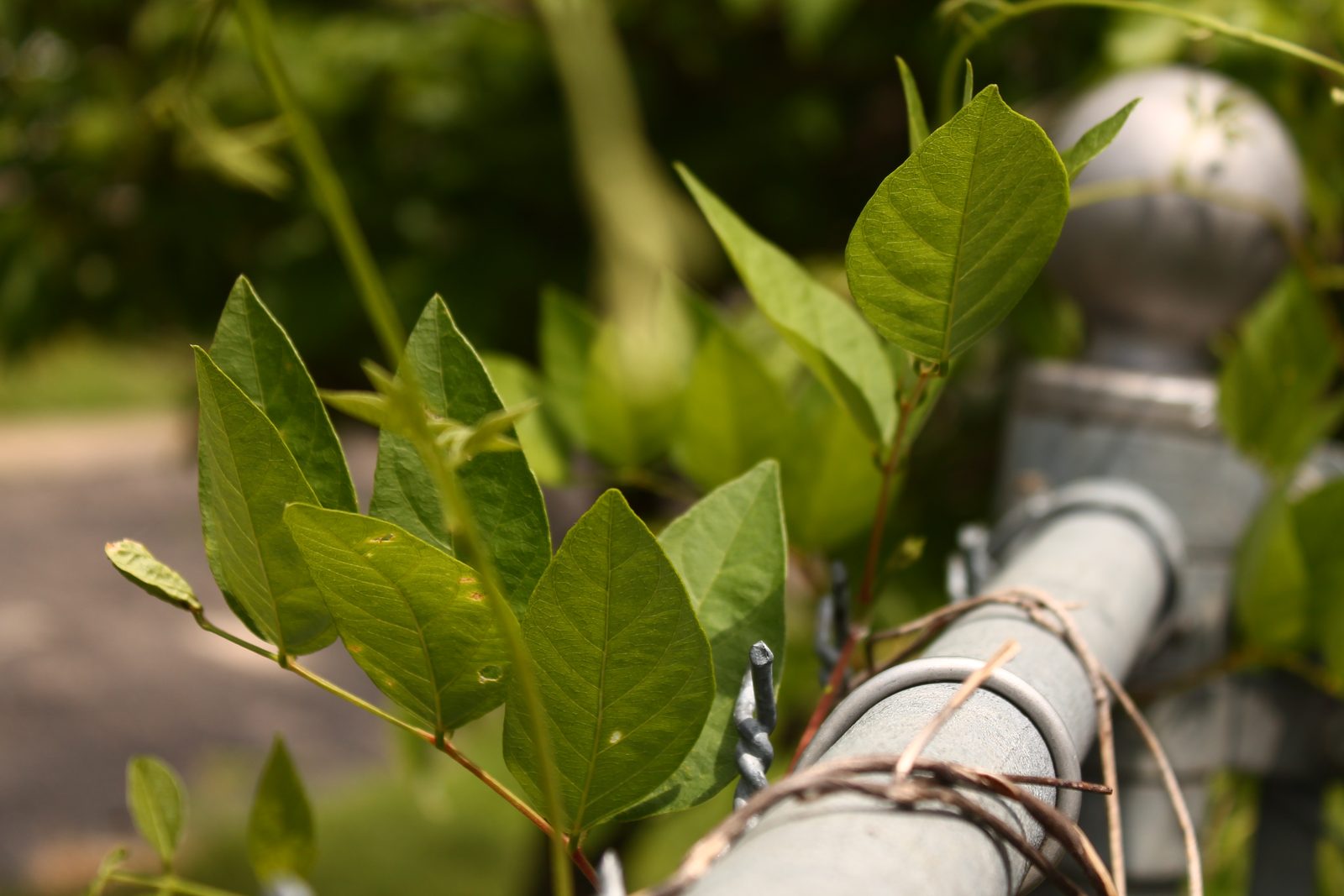
If you have spent much time digging around in your backyard, you have thought about those annoying plants crowding out your labor of love. Even if you do just a seasonal cleanup you will know the things that take over, their annoying consistency. You may have even wondered to yourself, "what is this thing? I have pulled it over and over, but it still comes back!" I have one of those right now. It is a vine that sends shoots out of the ground and climbs everything. It pulls down plants, takes over fence rows, tangles grasses. After pulling these out repeatedly I decided to dig up the whole root system to see what it was doing underground. I traced the shoot and found a tuberous bulb about the size of an acorn attached to a fibrous cord and then another tuber, this one the size of a small potato… then another, and another, all strung together like a set of pearls. Well, that's weird, in the trash they go.
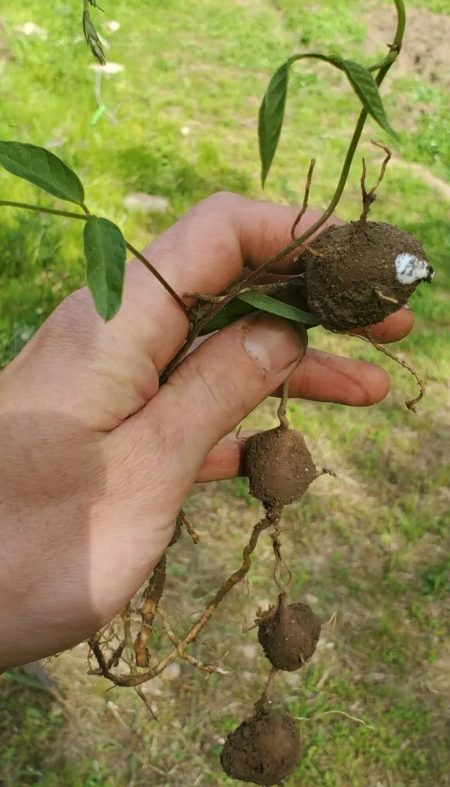
The tubers — strung along the root like a set of pearls.
I have been on a kick about plants that offer multifunctional roles. This is important when dealing with limited resources and space. I need a hedge row for privacy; can I find something that will also benefit local ecology? Does it look decent for a good part of the year? And if possible, can I round it out with something that offers medicinal or nutritional value to my family and I? With this framework in mind, I give you these recommendations. You can get them from Missouri Department of Conservation cheap, and once established, they take little effort to care for.
- Hazelnut shrub — Sun/part shade. Produces rich, versatile nuts used in everything from baking to spreads, while also supporting wildlife with food and shelter, improving soil health, and offering heart-healthy fats and vitamin E for people who eat them. Great for a privacy hedge.
- Wild ninebark — Sun/part shade. A tough, adaptable native shrub whose clusters of white to pinkish flowers attract bees and butterflies, while its dense form provides excellent cover and nesting habitat for birds.
- Serviceberry — Sun/part shade. Produces edible, nutrient-rich berries high in fiber, antioxidants, and vitamins that can be eaten raw or cooked into jams and baked goods, while also serving as an essential early-season nectar source for pollinators and a larval host for several butterfly species.
- Blackberry — Sun. A fruit-producing shrub whose berries, leaves, and roots offer both culinary and medicinal value.
Anyways, clearing out space for these kinds of obviously valuable plants takes me back to that damn vine I had been fighting and hating. I got fed up with it enough that I looked into it more, know thy enemy, and to my surprise found it had a name and a history. Hopniss, Apios, or as it's better known, the American Groundnut. It is a plant I had heard about and sought out for the exact multifunctionary properties Ive been thinking about... while ignorantly fighting it in the backyard.
Indigenous people harvested the Hopniss tubers via their Three Sisters Planting, along with maize and squash. The maize offers scaffolding for the Apios vine, the Apios then refeeds the soil as a Nitrogen fixer. The squash shades the soil to keep it moist. No indigenous group ever cultivated it, they would search out a Hopniss stand and cultivate their crops alongside the vine.
The groundnut gives food in the form of nuts on the vine and tubers underground. The tubers are described as being nutty and more flavorful than a potato. Almost sweet. Another small win for those looking for some multifunctional privacy hedge is if the plant is left to grow on a structure it will flourish without becoming woody and damaging.
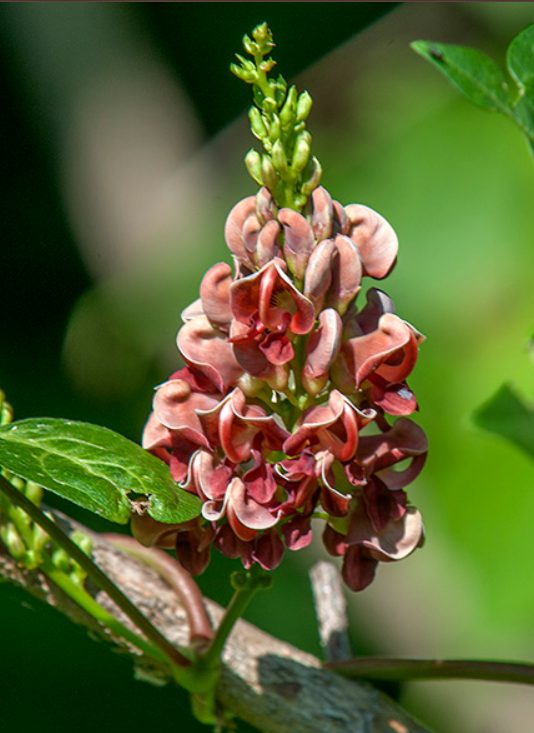
Hopniss in bloom.
Hopniss has still never been cultivated in North America, the tubers are hard for industrial agro to row crop and they have yet to find way to capitalize. However Japan and South Korea have adopted the American groundnut for research and widespread use in culinary dishes. They appreciate the great nutritional value Hopniss tubers apparently have. Their research shows they provide three times the protein and ten times the amount of calcium as a potato.
Will I be purposefully growing this as a crop? Probably not. Do I feel better knowing it's there? I do. What else is right in front of me, offering benefit, that I flat out deny?